Welcome to Pulse, the newsletter of the European Democrats.
The last few months of the year, as well as the first few days of 2026, have confirmed what the European Democratic Party has been saying for some time: democracy is under enormous pressure everywhere, both internally and externally. Authoritarian tendencies are on the rise in Europe and around the world, international balances are being disrupted and the rules-based global order is increasingly being called into question. What is happening in the United States – where the news in recent days has been shocking – directly affects all those who saw that country as a benchmark for rights and freedoms. But it is the impact of Donald Trump’s presidency on the international balance of power that requires a clear realisation: for Europe, the time to act is now or never. Indeed, there is an increasingly evident historical need for a more united, more efficient, more democratic Union that is more capable of influencing the international scene and more sovereign and autonomous. In a word, more federal. In this fragmented international context, the European Democrats continue to act as a force for democratic resilience, the defence of liberal values and pragmatic European reformism, holding high the banner of the rule of law and individual freedoms.
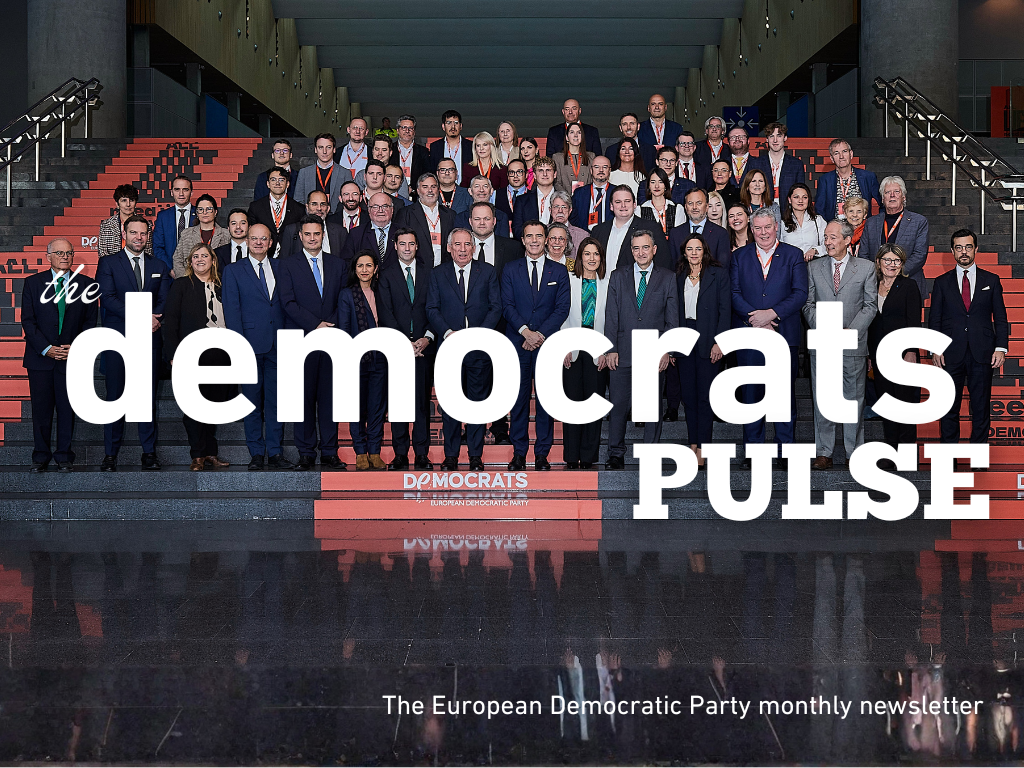
The European Democrats Congress in Bilbao: democracy, young people and a global vision
This commitment was at the heart of the EDP Congress in Bilbao in November, a decisive moment for the party’s political orientation. From the strong mobilisation of young people against authoritarianism to the proposal for a global alliance to defend democracy, the Congress reaffirmed the role of European Democrats as a bridge between European and international democratic forces. The protagonists of these two strands of debate were, on the one hand, young people from the United States, Ukraine, Serbia and Turkey, and on the other, guests from India and Japan, who enriched the discussion with a truly global perspective. The debates on the future of Europe between artificial intelligence, algorithms and geopolitics, with two keynote speeches by Paolo Benanti and Thierry Breton, made it clear that strategic autonomy, technological sovereignty and democratic governance are inseparable elements. The presence of new member parties and international guests gave new energy to the European project, confirming the EDP as the political home of those who believe in an open, strong and reformist Europe. As our Secretary General, Sandro Gozi, pointed out, in the face of nationalists and extremists who today cooperate much more than the defenders of democracy, the need to build a true global alliance of democrats is becoming increasingly evident, an alliance of which the European Democrats want to be the driving force.
Read the main article here
We were right: trade policy requires firmness and dialogue
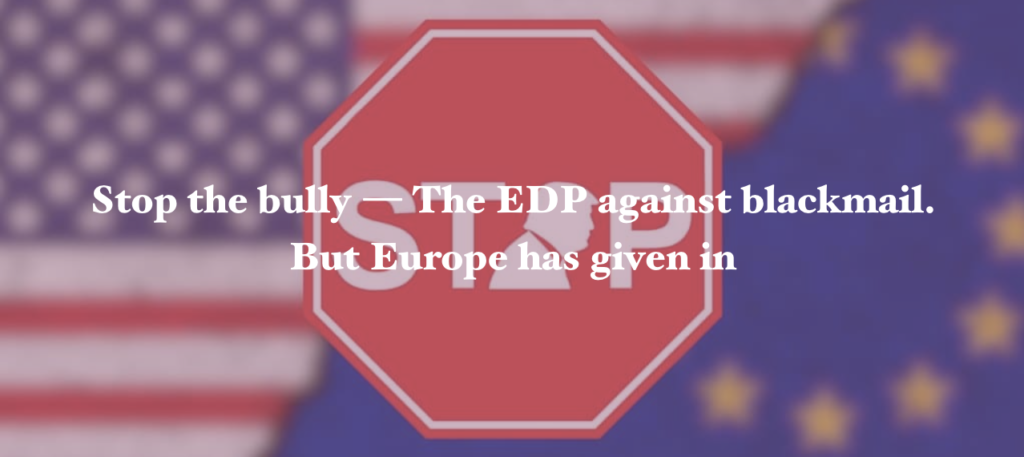
Recent geopolitical tensions have shown that clarity and consistency are essential and that, in the face of the Trump administration’s aggressive policies, it is necessary to respond with firmness, not complacency. In July, the EDP launched a very clear campaign entitled “Stop the bully” and criticised the agreement reached by Ursula von der Leyen at the US President’s private residence in Scotland. EDP President François Bayrou returned to this point with equally clear words in the following months. Stopping bullies does not mean closing the door to dialogue, but rejecting coercion and threats. Recent events, from pressure on Greenland to the use of tariffs as a tool for political blackmail, have confirmed the validity of this approach. Defending European interests requires credibility, unity and the ability to combine diplomacy with clear red lines based on international law.
Read about our July campaign here
Hungary: the rule of law and the democratic alternative
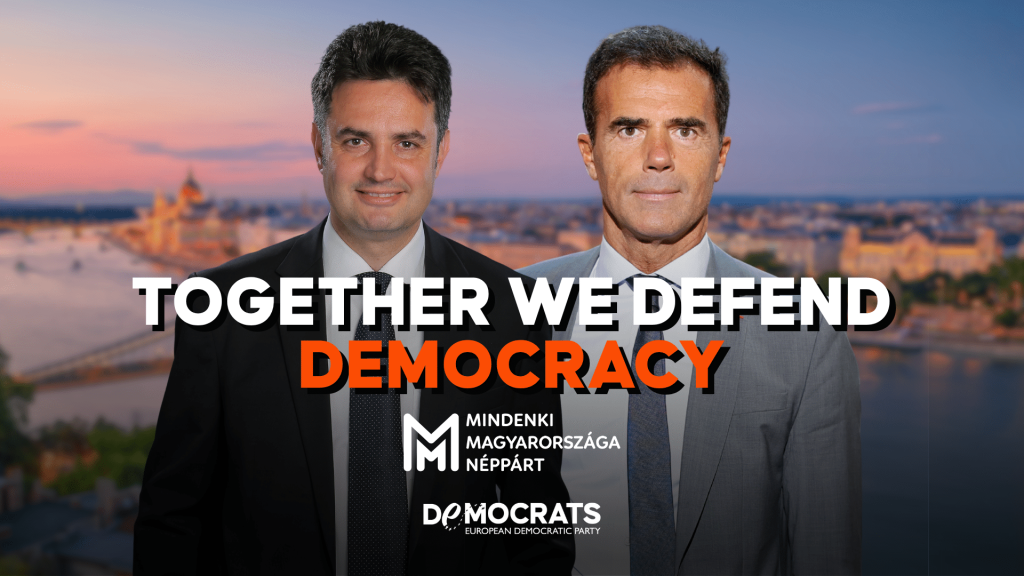
Hungary remains a crucial test case for European democracy and the rule of law. In this context, the EDP has sent two strong political signals. The accession of the MMN (Mindenki Magyarországa Néppárt), led by Péter Márki-Zay, to the European Democratic Party strengthens the democratic opposition and consolidates a clearly pro-European alternative in the country. At the same time, the EDP’s call for a European investigation into the very serious scandal of child abuse in Hungarian reformatories highlights the urgent need for EU-level oversight when national authorities fail to guarantee fundamental rights. Democracy cannot be selective, and the protection of fundamental rights, especially those of the most vulnerable, must remain non-negotiable.
This is all the more urgent given that Hungary will go to the polls next April, hopefully to turn the page on Viktor Orbán’s 16 years in power once and for all.

European citizens’ rights and major global events
The European Democrats have also brought European citizens’ rights to the forefront of major international events. Ahead of the 2026 FIFA World Cup in the United States, and in light of what is happening in American cities, where the use of force by ICE raises serious concerns about respect for fundamental rights, EDP Secretary General Sandro Gozi, together with other signatories, has called for binding guarantees for European teams and fans. Events of this magnitude must comply with clear standards on safety, rights and consumer protection.
Read the article here
Germany: spaces for dialogue on the future of Europe
Germany has been another key arena for political debate in recent months. From Ludwigsburg, where EDP MEP Engin Eroglu opened a new space for dialogue on the future of the European Union, to Bavaria, where MEP Christine Singer promoted a debate on agriculture, climate and the future of pastures, the party has fostered inclusive discussions capable of linking local realities to European solutions. The meeting in Bitburg on Europe’s role in the world, coordinated by MEP Joachim Streit, further emphasised the need for a coherent foreign policy commensurate with the Union’s economic weight and political responsibility. The debate with renowned journalist Jan Fleischhauer underscored the importance of open dialogue between European institutions, political forces and citizens.
In short: territories, multilateralism and digital
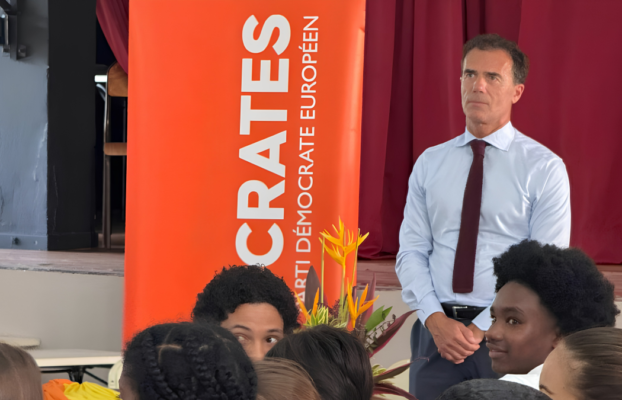
Alongside these main initiatives, the EDP continued to act on several fronts. In Guadeloupe, European Democrats Secretary General Sandro Gozi reinforced Europe’s commitment to overseas territories, promoting inclusion and equal opportunities. On a global level, Gozi also highlighted the validity of the African Union’s concerns about the US disengagement from important multilateral institutions, reiterating that Europe must strengthen its role and commitment to multilateralism. In the digital field, the EDP called for strict enforcement of the Digital Services Act against illegal online gambling advertising, in order to protect citizens and the integrity of the single market and made concrete proposals on the protection of minors.
As Europe enters a decisive phase, the European Democratic Party will continue to connect ideas, territories and political forces to defend democracy, strengthen the rule of law and lead a realistic but ambitious reform of the European Union. The coming months will be crucial, and the European Democrats are ready to play their part.